Bully Algorithm in Distributed System (original) (raw)
Last Updated : 23 Jul, 2025
The Bully Algorithm is a popular method for electing a coordinator in distributed systems. When nodes or processes in a system need a leader to manage tasks or make decisions, this algorithm helps them choose one, even if some nodes fail. The process involves nodes "bullying" each other by checking who has the highest ID, and the one with the highest ID becomes the coordinator.
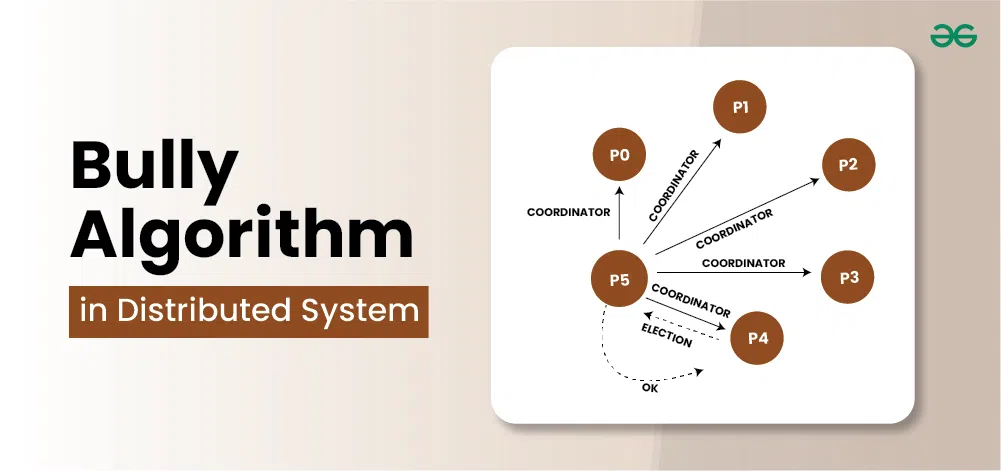
Bully Algorithm in Distributed System
Table of Content
- What is the Leader Election Algorithm?
- What is the Bully Algorithm for Leader Node Election?
- Messages in Bully Algorithm for Leader Node Election
- Steps Involved in Bully Algorithm for Leader Node Election
- Bully Algorithm Implementation
- Practical Applications of Bully Algorithm for Leader Election
- Benefits of the Bully Algorithm for Leader Election
- Challenges of the Bully Algorithm for Leader Election
What is the Leader Election Algorithm?
A crucial procedure in distributed systems is leader election, in which nodes (computers or processes) choose a leader from among themselves. Frequently, the group's leader takes on duties including decision-making, resource distribution, and coordination.
**The election algorithm is based on the following assumptions:
- Each process has a unique priority number.
- All processes in the system are fully connected.
- The process with the highest priority number will be elected as coordinator.
- Each process knows the process number of all other processes.
- During recovery, the failed process can take appropriate steps to resume the set of active processes.
What is the Bully Algorithm for Leader Node Election?
The Bully algorithm is a popular technique for choosing a leader in distributed networks that uses the greater priority concept. It operates as follows:
- **Initiation: When a node detects that the current leader has failed (usually through a timeout mechanism), it initiates an election.
- **Election Process:
- The initiating node sends an "election" message to all other nodes with higher priority.
- Nodes with higher priority respond by either acknowledging their current leader status or declaring themselves candidates.
- If no higher-priority node responds, the initiating node assumes leadership.
- **Notification: The newly elected leader informs all nodes of its leadership status, ensuring consistency across the distributed system.
Messages in Bully Algorithm for Leader Node Election
There can be three types of messages that processes exchange with each other in the bully algorithm:
- **Election message: Sent to announce election.
- **OK (Alive) message: Responds to the Election message.
- **Coordinator (Victory) message: Sent by winner of the election to announce the new coordinator.
Steps Involved in Bully Algorithm for Leader Node Election
Lets understand the steps involved in bully algorithm for leader Node Election through an example. The example follows all the assumptions discussed above in the Election Algorithm. Let's say there are 6 Processes P0, P1, P2, P3, P4, P5 written in ascending order of their Process ID (i.e.,0, 1,2,3,4,5).
Bully Algorithm Implementation
Below is the code of bully algorithm in java:
Java `
import java.util.ArrayList; import java.util.List;
// Class representing a node in the distributed system class Node { private int nodeId; private boolean isCoordinator;
public Node(int nodeId) {
    this.nodeId = nodeId;
    this.isCoordinator = false;
}

public int getNodeId() {
    return nodeId;
}

public boolean isCoordinator() {
    return isCoordinator;
}

public void setCoordinator(boolean coordinator) {
    isCoordinator = coordinator;
}

// Method to initiate an election
public void initiateElection(List<Node> nodes) {
    System.out.println("Node " + nodeId + " initiates election.");

    for (Node node : nodes) {
        if (node.getNodeId() > this.nodeId) {
            // Send election message to higher priority nodes
            node.receiveElectionMessage(this);
        }
    }

    // Assume election process completes after initiating
    becomeCoordinator();
}

// Method to receive election message from another node
public void receiveElectionMessage(Node sender) {
    System.out.println("Node " + nodeId + " receives election message from Node " + sender.getNodeId());

    // Respond if current node has higher priority
    if (this.nodeId > sender.getNodeId()) {
        System.out.println("Node " + nodeId + " responds to Node " + sender.getNodeId());
        sender.receiveResponse(this);
    }
}

// Method to receive response and acknowledge as coordinator
public void receiveResponse(Node sender) {
    System.out.println("Node " + nodeId + " receives response from Node " + sender.getNodeId());
}

// Method to become the coordinator
public void becomeCoordinator() {
    System.out.println("Node " + nodeId + " becomes the coordinator.");
    this.isCoordinator = true;
}
}
public class BullyAlgorithmExample {
public static void main(String[] args) {
    // Create nodes
    Node node1 = new Node(1);
    Node node2 = new Node(2);
    Node node3 = new Node(3);
    Node node4 = new Node(4);
    Node node5 = new Node(5);

    // List of nodes in the distributed system
    List<Node> nodes = new ArrayList<>();
    nodes.add(node1);
    nodes.add(node2);
    nodes.add(node3);
    nodes.add(node4);
    nodes.add(node5);

    // Simulate failure of current coordinator (Node 3)
    node3.setCoordinator(false);

    // Assume Node 3 detects coordinator failure and initiates election
    node3.initiateElection(nodes);
}
}
`
Explanation of the Code:
- **Node Class: Represents each node in the distributed system with attributes
nodeIdandisCoordinator. It includes methods for initiating an election (initiateElection), receiving election messages (receiveElectionMessage), handling responses (receiveResponse), and becoming the coordinator (becomeCoordinator). - **BullyAlgorithmExample Class: Contains the
mainmethod where nodes are created (node1tonode5). Nodes are added to a list (nodes) representing the distributed system. In this example,nodesinitiates an election due to a simulated failure of the current coordinator (node3itself). - **Output: When you run this code, it will simulate the election process and print messages indicating election initiation, message exchange, and the election outcome where a new coordinator node is elected based on their IDs.
This implementation is simplified and assumes a basic scenario. In practice, you would need to handle network communication, message exchange protocols, and potentially more complex failure scenarios to make the algorithm robust for real-world distributed systems.
Practical Applications of Bully Algorithm for Leader Election
Despite its simplicity, the Bully Algorithm finds useful applications in a variety of distributed systems situations where the election of a leader is essential to preserving system coordination and functionality. Here are a few real-world applications:
- **Distributed Databases:
- In distributed databases, nodes must agree on a leader to coordinate transactions, ensure data consistency, and handle queries efficiently.
- The Bully Algorithm can elect a node as the primary coordinator for managing database operations across multiple nodes.
- **Fault Tolerance:
- The Bully Algorithm swiftly identifies and swaps out malfunctioning leader nodes, improving fault tolerance.
- By facilitating the election of a new leader when a leader node becomes unresponsive due to a crash or network issue, the algorithm reduces interruption and guarantees the distributed system's continuing operation.
- **Decentralized Systems:
- In decentralized systems where nodes operate autonomously but occasionally need to synchronize or coordinate activities (e.g., peer-to-peer networks, IoT networks), the Bully Algorithm can elect a leader node responsible for controlling access, resource allocation, or data routing among peers.
- **High Availability Architectures:
- High availability architectures depend on leader election methods, such as the Bully Algorithm, to preserve redundancy and guarantee that services continue to function even in the event that individual nodes or components malfunction. In mission-critical applications and cloud computing settings, this is crucial.
- **Messaging Systems:
- In distributed messaging systems or event-driven architectures, the Bully Algorithm can designate a leader node responsible for managing message brokers, ensuring message delivery, and maintaining the consistency of event processing across distributed nodes.
Benefits of the Bully Algorithm for Leader Election
Below are the benefits of bully algorithm:
- **Fault Tolerance: The Bully Algorithm improves fault tolerance by quickly recognizing instances in which the present leader fails or stops responding. This ensures node failure resilience and remaining functioning by starting an election process to choose a new leader.
- **Decentralized Nature: It operates in a decentralized manner, allowing nodes to autonomously initiate elections based on local observations (such as timeouts or failure detection). This reduces reliance on a central coordinator and distributes leadership responsibilities across the network.
- **Simplicity and Efficiency: The algorithm works well in situations where a simple leader election process is sufficient because it is easy to understand and apply. It makes use of priority-based decision-making and simple message forwarding, which might be useful in settings where complexity must be kept to a minimum.
- **Scalability: As the number of nodes in the distributed system increases, the Bully Algorithm scales well. Each node interacts with a subset of other nodes during the election process based on their priority, which helps manage scalability without overwhelming network resources.
Challenges of the Bully Algorithm for Leader Election
Below are the challenges of Bully Algorithm:
- **Message Overhead: Nodes may need to exchange multiple messages during the election process, especially in larger networks or when nodes have similar priorities. This can introduce latency and increase network traffic, affecting overall system performance.
- **Priority Assignment: Assigning priorities or identifiers to nodes in a fair and accurate manner is crucial. Incorrect or inconsistent priority assignments can lead to improper leader elections or instability in leadership transitions.
- **Network Partitioning: During network partitions or transient connectivity issues, the Bully Algorithm may struggle to elect a leader or maintain consistency across all nodes. Nodes in isolated segments of the network may initiate separate elections, potentially leading to conflicting leadership claims.
- **Handling Concurrent Elections: If multiple nodes detect a leader failure simultaneously or experience network delays, they may initiate concurrent elections. Managing these concurrent elections to ensure a single leader is elected and acknowledged by all nodes requires careful coordination and message handling.
Conclusion
In distributed systems, the Bully Algorithm is a simple and fault-tolerant leader election technique. It performs well in small- to medium-sized networks, maintaining order in the event of a leader failure. However, it lacks preemption capabilities and its efficiency can drop in larger networks.