What is Leader Election in a Distributed System? (original) (raw)
Last Updated : 23 Jul, 2025
In distributed systems, leader election is a crucial process for maintaining coordination and consistency. It involves selecting a single node from a group to act as the leader, responsible for managing tasks and decision-making. This process ensures that the system operates efficiently and can recover from failures. Leader election algorithms are designed to handle various challenges, including node failures and network partitions, making them fundamental to the robustness and reliability of distributed systems.
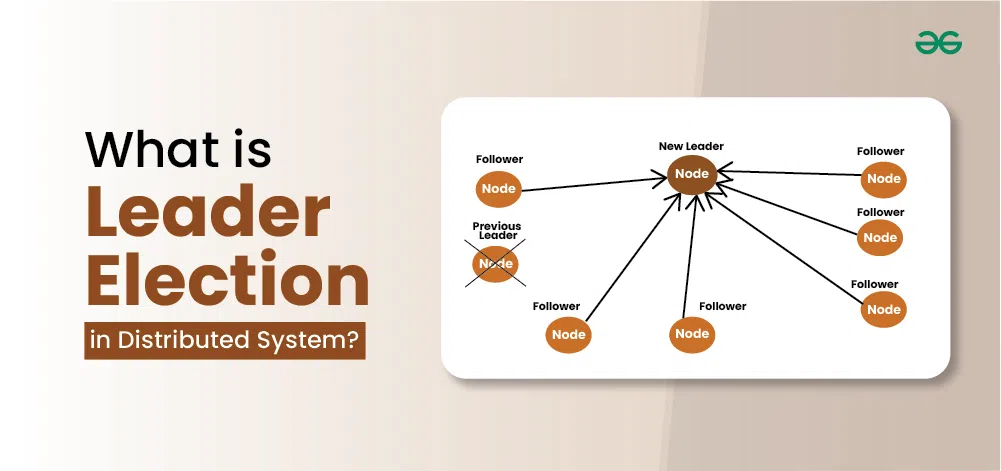
Leader Election in a Distributed System
Important Topics to Understand Leader Election in a Distributed System
- What is Leader Election in Distributed Systems?
- Importance of Leader Election in Distributed Systems
- Leader Election Algorithms in Distributed Systems
- Challenges and Considerations for Leader Election in Distributed Systems
- Applications of Leader Election in Distributed Systems
- FAQs on Leader Election in Distributed Systems
What is Leader Election in Distributed Systems?
Leader election in distributed systems is a fundamental process where a group of nodes collaboratively selects one node to act as a leader. This leader assumes a central role, handling tasks such as coordination, resource allocation, or decision-making. The purpose of leader election is to ensure efficient operation, consistency, and fault tolerance within the system.
**Leader election is essential for various reasons:
- **Coordination: The leader manages shared resources and synchronizes actions among nodes, preventing conflicts and ensuring smooth operations.
- **Fault Tolerance: In the event of a leader failure, the system must elect a new leader to maintain functionality and prevent system downtime.
- **Consistency: The leader ensures that all nodes follow a consistent state, which is critical for systems requiring agreement on data or actions.
Algorithms for leader election, like the Bully algorithm or the Paxos protocol, are designed to handle network partitions, node failures, and other challenges, ensuring the system remains robust and reliable.
Importance of Leader Election in Distributed Systems
Leader election is crucial in distributed systems for several reasons:
- **Coordination and Consensus: A leader helps in synchronizing actions and making collective decisions, which is vital for maintaining consistency and order among distributed nodes. Without a leader, coordinating tasks like data replication, configuration changes, or updates becomes chaotic and error-prone.
- **Resource Management: In many distributed systems, certain tasks, such as load balancing or resource allocation, require a central authority. The leader can efficiently manage these resources, preventing conflicts and ensuring optimal use.
- **Fault Tolerance and Recovery: Leader election ensures that the system can recover from failures. If the current leader fails, a new leader is elected, maintaining system continuity and reducing downtime. This resilience is crucial for systems that require high availability.
- **System Efficiency: By delegating certain responsibilities to a single leader, the system can reduce redundancy and streamline processes. This centralized management helps in reducing communication overhead and improving overall efficiency.
- **Consistency Maintenance: In distributed databases or file systems, the leader ensures that all nodes remain in a consistent state. This avoids issues like data divergence or conflicting updates, which are crucial for maintaining data integrity.
Leader Election Algorithms in Distributed Systems
Leader election algorithms are designed to select a single node from a group of distributed nodes to act as the leader. These algorithms are essential for ensuring coordination, consistency, and fault tolerance in distributed systems. Here’s an overview of some commonly used leader election algorithms:
1. **Bully Algorithm
- **How It Works:
- Nodes are assigned unique identifiers.
- When a node (let’s call it node A) notices that the leader has failed or is not responsive, it initiates an election process.
- Node A sends an election message to all nodes with higher IDs.
- If a higher-ID node responds, the election process is aborted, and the higher-ID node takes over as the leader.
- If no response is received, node A is declared the leader.
- **Pros:
- Simple to implement.
- Effective in environments where nodes can be easily identified and are relatively stable.
- **Cons:
- High communication overhead in large systems.
- Not very efficient in cases of frequent leader changes or network partitions.
2. **Ring Algorithm
- **How It Works:
- Nodes are arranged in a logical ring, with each node only knowing about its immediate successor.
- When a node detects a need for a new leader, it initiates an election by sending an election message around the ring.
- Each node appends its ID to the message and forwards it to the next node.
- The message eventually returns to the initiator, who then selects the node with the highest ID as the leader.
- **Pros:
- Efficient in terms of message complexity, with only one message circulating the ring.
- Fairly simple and predictable.
- **Cons:
- Relies on a stable ring structure; changes in the network can complicate the algorithm.
- Can be slow in large systems due to the message’s round-trip time.
3. **Paxos Algorithm
- **How It Works:
- Paxos is more complex but is designed for consensus rather than just leader election.
- It involves multiple phases: proposing a value, accepting a value, and learning the value.
- Nodes propose values, and through a series of messages, they agree on a single value which is chosen as the leader or decision-maker.
- **Pros:
- Provides strong consistency and fault tolerance.
- Well-suited for systems requiring robust consensus mechanisms.
- **Cons:
- Complex to implement and understand.
- Can involve significant communication overhead.
4. **Raft Algorithm
- **How It Works:
- Raft divides the leader election process into simpler phases: candidate, leader, and follower.
- Nodes start as followers. If a follower doesn’t hear from the leader within a certain timeout, it becomes a candidate and initiates an election.
- Candidates request votes from other nodes. A candidate becomes the leader if it receives a majority of votes.
- The leader handles client requests and replicates log entries to followers.
- **Pros:
- More understandable and implementable compared to Paxos.
- Designed to handle network partitions and leader failures gracefully.
- **Cons:
- Requires a majority of nodes to be operational for elections and consistency.
- Performance can be affected if nodes frequently fail or recover.
Challenges and Considerations for Leader Election in Distributed Systems
Leader election in distributed systems presents several challenges and considerations due to the nature of distributed environments. Here’s an overview of the key challenges and considerations:
1. **Fault Tolerance
- **Challenge: In a distributed system, nodes can fail or become unreachable due to various reasons like network issues or hardware failures. The leader election mechanism must handle such failures gracefully to ensure that the system remains operational.
- **Considerations:
- **Detection: Implement robust mechanisms to detect node failures promptly.
- **Redundancy: Design the system to recover from leader failure by electing a new leader quickly.
- **Consistency: Ensure that the system remains consistent even if the leader fails and a new one is elected.
2. **Scalability
- **Challenge: As the number of nodes in the system increases, the leader election algorithm must efficiently handle larger scale without introducing significant overhead or delays.
- **Considerations:
- **Algorithm Efficiency: Choose or design algorithms that scale well with the number of nodes.
- **Communication Overhead: Minimize the number of messages exchanged during the leader election process to reduce network load.
- **Latency: Ensure that the time taken to elect a leader remains acceptable even as the system grows.
3. **Performance and Efficiency
- **Challenge: The leader election process can impact the performance of the distributed system. It should be efficient in terms of both time and resources.
- **Considerations:
- **Algorithm Complexity: Prefer algorithms with lower time complexity and minimal resource consumption.
- **Optimization: Optimize the leader election process to minimize impact on overall system performance.
- **Trade-offs: Balance between efficiency and robustness. More complex algorithms may offer better fault tolerance but at the cost of performance.
4. **Handling Network Partitions
- **Challenge: Network partitions can occur, splitting the system into isolated segments. This can complicate leader election as different segments might elect different leaders or become inconsistent.
- **Considerations:
- **Partition Tolerance: Implement algorithms that can handle network partitions and ensure that a consistent leader is elected across partitions.
- **Consensus Mechanisms: Use consensus algorithms that are resilient to network partitions, like Paxos or Raft, which are designed to handle such scenarios.
- **Recovery: Ensure that the system can recover and reconcile inconsistencies once network partitions are resolved.
Applications of Leader Election in Distributed Systems
Leader election plays a pivotal role in distributed systems, impacting various applications by ensuring coordination, consistency, and fault tolerance. Here are some key applications:
1. **Distributed Databases
- **Application: Maintaining a single, consistent view of data across multiple nodes.
- **Role of Leader Election:
- **Coordination: The leader handles tasks such as coordinating updates, managing transactions, and ensuring that all nodes in the distributed database remain consistent.
- **Consistency: Ensures that all nodes agree on the order of operations and data updates, preventing issues like conflicting writes or data divergence.
2. **Distributed File Systems
- **Application: Managing and accessing files across multiple servers or nodes.
- **Role of Leader Election:
- **Metadata Management: A leader node may manage metadata operations, such as file location and access permissions, ensuring that metadata remains consistent and up-to-date.
- **Synchronization: Coordinates file replication and ensures consistency across different nodes, improving reliability and fault tolerance.
3. **Load Balancing
- **Application: Distributing incoming requests or workloads evenly across multiple servers.
- **Role of Leader Election:
- **Task Allocation: The leader node may oversee the distribution of requests or workloads, ensuring efficient load balancing and optimal resource utilization.
- **Decision Making: Handles decisions on scaling up or down and reallocating resources based on current load and system performance.
4. **Cluster Management
- **Application: Managing a group of interconnected servers or nodes that work together as a cluster.
- **Role of Leader Election:
- **Resource Management: The leader coordinates resource allocation and task scheduling among nodes, improving cluster efficiency and performance.
- **Fault Tolerance: Oversees failover processes and redistributes tasks when nodes fail or recover.
Conclusion
In conclusion, leader election is a critical process in distributed systems, essential for ensuring coordinated and reliable operation. Effective leader election mechanisms must address challenges such as fault tolerance, scalability, performance, and network partitions while maintaining fairness and liveness. By selecting appropriate algorithms and implementing robust solutions, systems can achieve reliable leadership management and sustain operational integrity.