Unsupervised Machine Learning (original) (raw)
Last Updated : 30 Apr, 2026
Unsupervised Learning is a type of machine learning where the model works without labelled data. It learns patterns on its own by grouping similar data points or finding hidden structures without any human intervention.
- It is used for tasks like clustering, dimensionality reduction and Association Rule Learning.
- Helps identify hidden patterns in data
- Useful for grouping, compression and anomaly detection
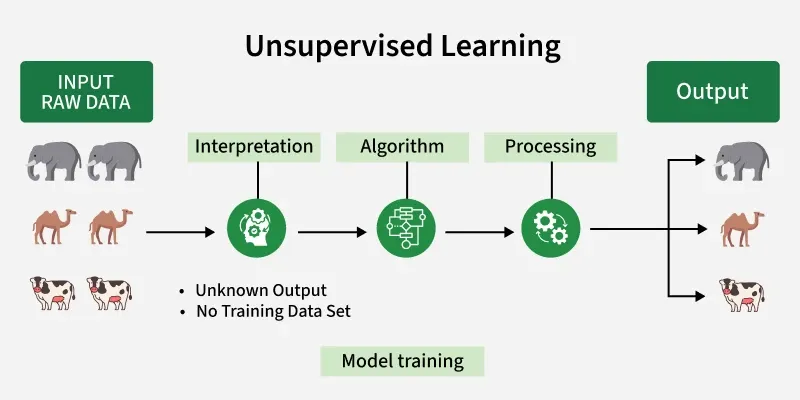
Unsupervised Learning
The image shows set of animals like elephants, camels and cows that represents raw data that the unsupervised learning algorithm will process.
- The "Interpretation" stage signifies that the algorithm doesn't have predefined labels or categories for the data. It groups the data based on inherent patterns.
- An algorithm represents unsupervised learning process that helps to identify patterns in the data.
- The processing stage shows the algorithm working on the data.
The output shows the results of the unsupervised learning process. In this case, the algorithm might have grouped the animals into clusters based on their species (elephants, camels, cows).
Working of Unsupervised Learning
The working of unsupervised machine learning can be explained in these steps:
**1. Collect Unlabeled Data
- Gather a dataset without predefined labels or categories.
- **Example: Images of various animals without any tags.
**2. Select an Algorithm
- Choose a suitable unsupervised algorithm such as clustering like K-Means, association rule learning like Apriori or dimensionality reduction like PCA based on the goal.
**3. Train the Model on Raw Data
- Feed the entire unlabeled dataset to the algorithm.
- The algorithm looks for similarities, relationships or hidden structures within the data.
**4. Group or Transform Data
- The algorithm organizes data into groups (clusters), rules or lower-dimensional forms without human input.
- Example: It may group similar animals together or extract key patterns from large datasets.
**5. Interpret and Use Results
- Analyze the discovered groups, rules or features to gain insights or use them for further tasks like visualization, anomaly detection or as input for other models.
Unsupervised Learning Algorithms
There are mainly 3 types of Unsupervised Algorithms that are used:
1. Clustering Algorithms
Clustering is an unsupervised machine learning technique that groups unlabeled data into clusters based on similarity. Its goal is to discover patterns or relationships within the data without any prior knowledge of categories or labels.
- Groups data points that share similar features or characteristics.
- Helps find natural groupings in raw, unclassified data.
- Commonly used for customer segmentation, anomaly detection and data organization.
- Works purely from the input data without any output labels.
- Enables understanding of data structure for further analysis or decision-making.
Some common clustering algorithms:
- **K-means Clustering****:** Groups data into K clusters based on how close the points are to each other.
- **Hierarchical Clustering****:** Creates clusters by building a tree step-by-step, either merging or splitting groups.
- **Density-Based Clustering (DBSCAN)****:** Finds clusters in dense areas and treats scattered points as noise.
- **Mean-Shift Clustering****:** Discovers clusters by moving points toward the most crowded areas.
- **Spectral Clustering****:** Groups data by analyzing connections between points using graphs.
2. Association Rule Learning
Association rule learning is a rule-based unsupervised learning technique used to discover interesting relationships between variables in large datasets. It identifies patterns in the form of “if-then” rules, showing how the presence of some items in the data implies the presence of others.
- Finds frequent item combinations and the rules connecting them.
- Commonly used in market basket analysis to understand product purchase relationships.
- Helps retailers design promotions and cross-selling strategies.
Some common Association Rule Learning algorithms:
- **Apriori Algorithm****:** Finds patterns by exploring frequent item combinations step-by-step.
- **FP-Growth Algorithm****:** An Efficient Alternative to Apriori. It quickly identifies frequent patterns without generating candidate sets.
- **Eclat Algorithm****:** Uses intersections of itemsets to efficiently find frequent patterns.
- **Efficient Tree-based Algorithms****:** Scales to handle large datasets by organizing data in tree structures.
3. Dimensionality Reduction
Dimensionality reduction is the process of decreasing the number of features or variables in a dataset while retaining as much of the original information as possible. This technique helps simplify complex data making it easier to analyze and visualize. It also improves the efficiency and performance of machine learning algorithms by reducing noise and computational cost.
- It reduces the dataset’s feature space from many dimensions to fewer, more meaningful ones.
- Helps focus on the most important traits or patterns in the data.
- Commonly used to improve model speed and reduce overfitting.
Here are some popular Dimensionality Reduction algorithms:
- **Principal Component Analysis (PCA)****:** Reduces dimensions by transforming data into uncorrelated principal components.
- **Non-negative Matrix Factorization (NMF)****:** Breaks data into non-negative parts to simplify representation.
- **Locally Linear Embedding (LLE): Reduces dimensions while preserving the relationships between nearby points.
- **Isomap: Captures global data structure by preserving distances along a manifold.
Applications
- **Customer Segmentation: Algorithms cluster customers based on purchasing behavior or demographics, enabling targeted marketing strategies.
- **Anomaly Detection: Identifies unusual patterns in data, aiding fraud detection, cybersecurity and equipment failure prevention.
- **Recommendation Systems: Suggests products, movies or music by analyzing user behavior and preferences.
- **Image and Text Clustering: Groups similar images or documents for tasks like organization and content recommendation.
- **Social Network Analysis: Detects communities or trends in user interactions on social media platforms.
Advantages
- Works with raw, unlabeled data, saving time and effort required for data annotation.
- Finds hidden patterns and natural groupings in data that may not be easily identified by humans.
- Handles large and complex datasets efficiently, including high-dimensional data.
- Helps detect anomalies and unusual data points without needing prior examples.
Challenges
- Noisy data and outliers can distort patterns and reduce the effectiveness of the model.
- Models may capture noise instead of meaningful patterns, leading to overfitting.
- Lack of labeled data makes it difficult to guide the algorithm toward specific outcomes.
- Results such as clusters may be difficult to interpret or may not clearly match real-world categories.