Shared Nothing Architecture (original) (raw)
Last Updated : 23 Jul, 2025
In modern computing, scalability and resilience are very important. As applications and data volumes continue to grow exponentially, traditional architectures struggle to meet the demands of today’s dynamic digital landscape. Enter Shared Nothing Architecture (SNA), a design paradigm that promises to revolutionize how we approach system scalability and fault tolerance.
In this article, we delve deep into the principles, benefits, challenges, and best practices of shared-nothing architecture. We explore real-world use cases across industries—from e-commerce giants managing peak traffic to fintech platforms executing high-frequency trades—and examine how SNA fosters innovation in fields like IoT, gaming, and beyond.

Important Topics for Shared Nothing Architecture
- What is Shared Nothing Architecture?
- Importance in System Design
- Key Components of Shared Nothing Architecture
- Benefits of Shared Nothing Architecture
- Challenges of Shared Nothing Architecture
- Implementation Strategies of Shared Nothing Architecture
- Use Cases of Shared Nothing Architecture
- Best Practices for Designing Shared Nothing Systems
Shared Nothing Architecture (SNA) is a distributed computing architecture where each node (or server) in the system is independent and self-sufficient. This means that nodes do not share memory or storage; they only communicate with each other through a network. Here are the key characteristics and benefits of Shared Nothing Architecture:
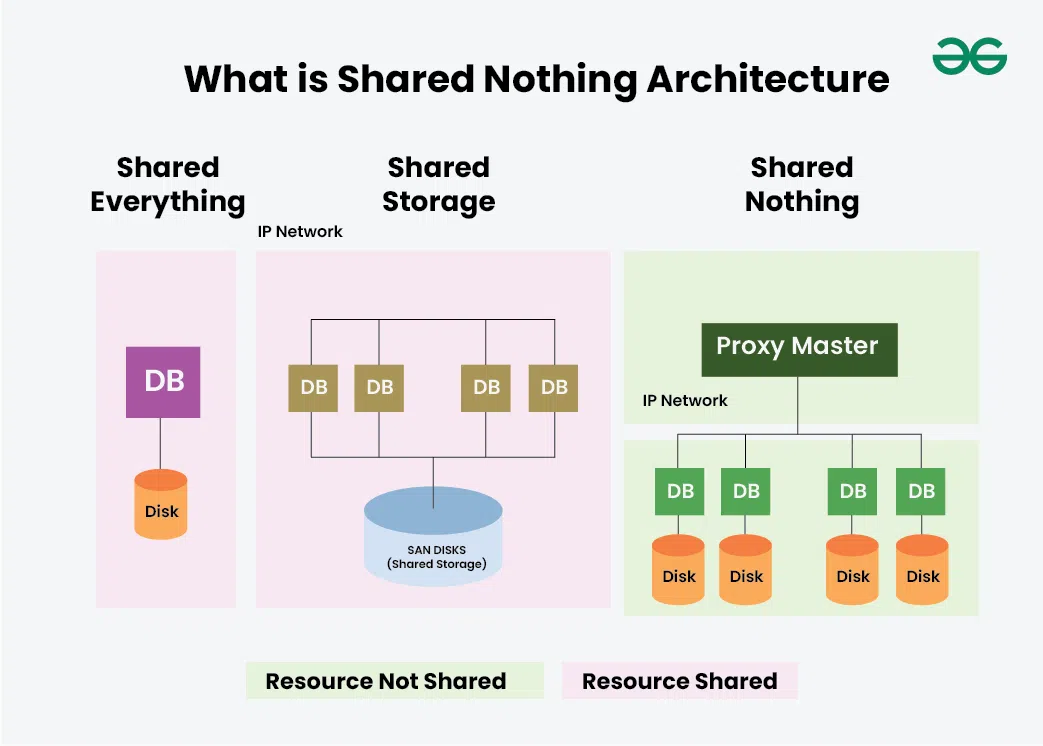
Characteristics of Shared Nothing Architecture
- **Independence: Each node operates independently and does not share disk storage or RAM with other nodes. Nodes communicate via network protocols, such as TCP/IP.
- **Scalability: The architecture can easily scale horizontally by adding more nodes without significant changes to the existing setup. Each additional node brings its own memory and storage, enhancing the system's overall capacity and performance.
- **Fault Isolation: Since nodes are independent, the failure of one node does not directly affect others. Faults are isolated to individual nodes, making the system more resilient.
- **Data Distribution: Data is partitioned across the nodes, often using techniques like sharding. Each node is responsible for a specific subset of the data.
- **Parallel Processing: Multiple nodes can perform operations concurrently on different partitions of the data, leading to significant performance improvements for large-scale tasks.
Importance of Shared Nothing Architecture in System Design
Shared Nothing Architecture (SNA) plays a significant role in system design, especially for distributed systems, due to its various advantages and impact on performance, scalability, and reliability. Here's why SNA is important in system design:
- **Scalability
- Systems can be scaled out by adding more nodes without major modifications. This is crucial for handling increasing loads and growing datasets.
- Each new node brings its own storage and computing resources, directly enhancing the system's overall capacity.
- **Performance
- Tasks can be distributed across multiple nodes, enabling parallel processing and significantly improving performance for large-scale computations.
- Reduced contention for resources since nodes operate independently.
- **Reliability and **Fault Tolerance
- Failure of one node does not affect the others, ensuring that the system remains operational even if parts of it fail.
- This leads to higher availability and reliability, which is critical for systems requiring continuous uptime.
- **Maintenance and Manageability
- Nodes can be maintained, upgraded, or replaced independently, simplifying system management.
- Reduced downtime for maintenance activities as other nodes can continue to operate normally.
- **Cost-Effectiveness
- Organizations can start with a smaller number of nodes and scale out as needed, aligning infrastructure costs with business growth.
- Avoids the high initial investment in large, monolithic systems.
- **Flexibility
- The architecture supports a modular approach, where different components of the system can be developed, tested, and deployed independently.
- This flexibility facilitates rapid development and deployment cycles.
Shared Nothing Architecture (SNA) is structured to maximize independence and parallelism among nodes in a distributed system. Here are the key components that typically make up an SNA system:
1. **Nodes
- Each node is a self-contained server with its own CPU, memory, and storage.
- Nodes do not share these resources with one another, ensuring no single point of contention.
2. **Data Partitioning
- Data is partitioned across nodes using a method called sharding. Each shard contains a subset of the data, and each node manages one or more shards.
- Sharding can be based on various criteria like ranges of values, hash functions, or geographic distribution.
3. **Network Communication
- Nodes communicate with each other via network protocols (e.g., TCP/IP).
- This communication is essential for coordinating operations, replicating data, and ensuring consistency.
4. **Replication and Redundancy
- To ensure high availability and fault tolerance, data is often replicated across multiple nodes.
- Replication strategies can be synchronous or asynchronous, depending on the consistency requirements.
5. **Load Balancing
- Load balancers distribute incoming requests evenly across nodes to ensure no single node becomes a bottleneck.
- This helps in optimizing resource utilization and maintaining high performance.
6. **Distributed Query Processing
- For databases, query processing is distributed among nodes. A central coordinator may break down queries into sub-queries that are processed in parallel by different nodes.
- The results are then aggregated and returned to the client.
Shared Nothing Architecture (SNA) offers several significant benefits that make it an attractive choice for designing scalable, high-performance, and reliable systems. Here are the key benefits:
1. **Scalability
- **Horizontal Scalability:
- New nodes can be added to the system without disrupting existing operations. This is known as horizontal scaling, where additional nodes provide more computational power, storage, and bandwidth.
- **Elasticity:
- Resources can be adjusted dynamically based on demand, allowing systems to handle varying workloads efficiently. This elasticity is particularly beneficial in cloud environments.
2. **Performance
- **Parallel Processing:
- Multiple nodes can perform operations in parallel, significantly improving the performance of data-intensive tasks such as big data processing, analytics, and real-time applications.
- **Resource Isolation:
- Since each node has its own dedicated resources (CPU, memory, storage), there is no competition for shared resources, leading to predictable and optimal performance.
3. **Reliability and Availability
- **Fault Tolerance:
- The failure of one node does not affect the operation of other nodes. Faults are isolated, enhancing the overall reliability and robustness of the system.
- **High Availability:
- Redundant data and processes across multiple nodes ensure that the system remains available even if some nodes fail. This redundancy is crucial for mission-critical applications.
4. **Maintenance and Management
- **Simplified Maintenance:
- Maintenance, upgrades, and repairs can be performed on individual nodes without affecting the entire system. This simplifies system management and reduces downtime.
- **Independent Development and Deployment:
- Teams can develop, deploy, and upgrade different parts of the system independently, speeding up development cycles and enhancing flexibility.
5. **Cost Efficiency
- **Pay-as-You-Grow Model:
- Organizations can start with a minimal setup and add resources incrementally as needed, optimizing costs and avoiding large upfront investments.
- **Resource Optimization:
- By distributing workloads and storage, SNA ensures better utilization of resources, reducing waste and operational costs.
6. **Adaptability to Modern Technologies
- **Cloud Computing:
- SNA’s design aligns well with cloud computing models, where resources can be dynamically allocated and scaled across distributed nodes, ensuring efficient and reliable service delivery.
- **Microservices Architecture:
- SNA complements microservices architecture by allowing each service to run independently on separate nodes, promoting loose coupling and high modularity.
While Shared Nothing Architecture (SNA) offers numerous benefits, it also presents several challenges that need to be addressed to ensure the effective functioning of a distributed system. Here are some key challenges associated with SNA:
- **Architectural Complexity:
- Designing an SNA system involves complex architectural decisions, such as data partitioning, network communication, and fault tolerance mechanisms.
- **Implementation Overhead:
- Implementing these designs requires sophisticated algorithms and robust infrastructure, which can be time-consuming and resource-intensive.
- **Consistency Models:
- Maintaining data consistency across multiple nodes is challenging. Techniques like eventual consistency, strong consistency, and distributed transactions need to be carefully implemented to meet application requirements.
- **Performance Impact:
- The performance of an SNA system heavily relies on network communication. High network latency or insufficient bandwidth can degrade the overall performance.
- **Network Partitions:
- Handling network partitions (situations where nodes cannot communicate with each other) and ensuring the system remains operational is a significant challenge.
- **Recovery Mechanisms:
- Implementing efficient recovery mechanisms to redistribute data and processing tasks from failed nodes to healthy ones can be complex.
- **Balanced Data Distribution:
- Ensuring that data is evenly distributed across nodes to prevent hotspots (nodes with disproportionately high loads) requires effective sharding strategies.
- **Dynamic Load Balancing:
- Dynamically balancing the load across nodes as workloads fluctuate can be difficult to achieve without impacting performance.
Implementing Shared Nothing Architecture (SNA) involves several strategic decisions and design principles to ensure the system is scalable, reliable, and high-performing. Here are key implementation strategies:
1. **Data Partitioning and Sharding
- Split the database into smaller, more manageable pieces called shards. Each shard is a subset of the data, typically based on a specific criterion like a hash of a key or a range of values.
- **Example: In a user database, partition users by their geographical location or user ID ranges.
- Implement dynamic sharding mechanisms that can adapt to changing data volumes and access patterns. This involves automatic splitting or merging of shards as needed.
2. **Replication and Redundancy
- Replicate data asynchronously across nodes to ensure high availability. This allows nodes to continue operating even if some replicas are temporarily out of sync.
- **Example: Systems like Cassandra use asynchronous replication to achieve eventual consistency.
- Store multiple copies of data across different nodes to prevent data loss and ensure fault tolerance. Use replication strategies that balance consistency and performance needs.
3. **Load Balancing
- Use load balancers to distribute incoming requests evenly across nodes. This prevents any single node from becoming a bottleneck and ensures optimal resource utilization.
- **Example: Load balancers like NGINX or HAProxy can distribute web traffic across multiple web servers.
- Implement dynamic load balancing mechanisms that can adjust to changing loads in real-time, redistributing requests based on current node performance and availability.
4. **Fault Tolerance and Recovery
- Continuously monitor the health of nodes using regular health checks. Implement monitoring tools that can detect and report node failures promptly.
- **Example: Monitoring systems like Prometheus or Nagios can provide real-time health data.
- Develop automated recovery processes that can redistribute data and workloads from failed nodes to healthy ones. Ensure minimal disruption and quick recovery.
Shared Nothing Architecture (SNA) finds applications across various domains where scalability, reliability, and performance are crucial. Here are some notable use cases:
- SNA is well-suited for distributed databases handling massive datasets, such as Apache Cassandra or Amazon DynamoDB. Each node in these systems independently manages a portion of the data, allowing them to scale horizontally by adding more nodes.
- In databases like Google Spanner or CockroachDB, SNA enables parallel query processing across distributed nodes, enhancing performance for complex queries.
- CDNs like Akamai or Cloudflare use SNA to cache and deliver content efficiently to users worldwide. Nodes at edge locations store and serve content based on proximity to end-users, reducing latency and improving user experience.
- Cloud platforms such as AWS or Azure leverage SNA to provide scalable infrastructure services like compute instances, storage, and databases. Nodes can be dynamically added or removed based on demand, ensuring optimal resource utilization.
- Microservices deployed in containers (e.g., Kubernetes clusters) often use SNA principles to distribute services across nodes, achieving fault isolation and scalability for individual microservices.
Designing Shared Nothing Systems (SNA) requires careful consideration of various factors to ensure scalability, reliability, performance, and maintainability. Here are some best practices to follow when designing Shared Nothing Systems:
- Use effective data partitioning strategies (e.g., range partitioning, hash partitioning) to distribute data evenly across nodes. Consider factors like data access patterns and workload characteristics.
- Balance shard sizes to avoid hotspots and ensure even distribution of load. Monitor and adjust shard boundaries as data grows or access patterns change.
- Implement data replication across nodes to ensure high availability and fault tolerance. Choose appropriate replication strategies (e.g., synchronous vs. asynchronous) based on consistency and performance requirements.
- Ensure each node operates independently with its own resources (CPU, memory, storage). This isolation prevents a single node failure from affecting others.
- Design systems to scale horizontally by adding more nodes as demand increases. Use load balancers and auto-scaling groups to distribute load and manage resources dynamically.
- Choose appropriate consistency models (e.g., eventual consistency, strong consistency) based on application requirements. Use distributed consensus protocols (e.g., Paxos, Raft) for maintaining consistency across nodes.
- Implement conflict resolution mechanisms for handling concurrent updates to the same data across distributed nodes. Use versioning or timestamp-based strategies to resolve conflicts.
- Deploy centralized monitoring tools to track the health, performance, and operational metrics of all nodes and services. Use dashboards and alerts to detect anomalies and performance bottlenecks.