Top 20 Skills Required to Become a Data Scientist [2025 Updated] (original) (raw)
Last Updated : 23 Jul, 2025
Over the last five years, **data scientists have become one of the most in-demand jobs worldwide. As soon as companies started realizing the importance of data in their businesses, the demand started growing in every sector. But the path to becoming a successful **data scientist is not as easy as it may sound, it requires a certain set of skills that companies look for.
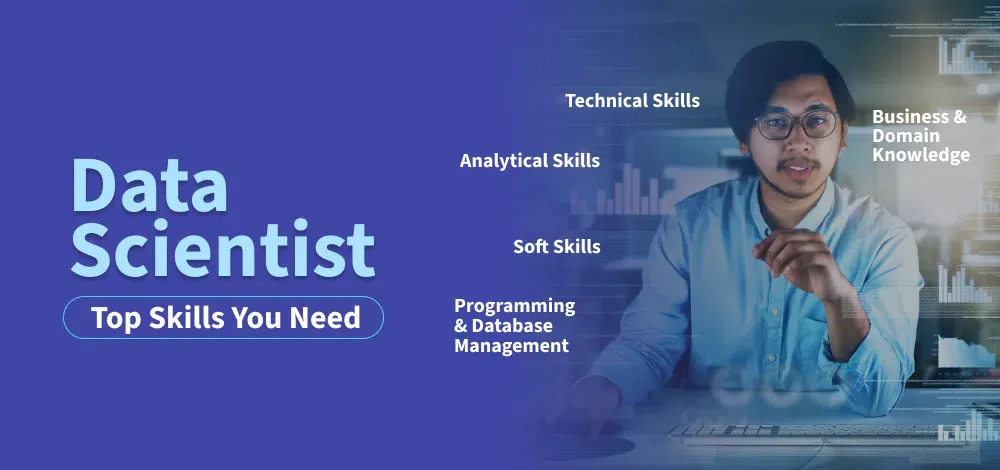
Top Skills for Data Scientists
This article explores the **Top 20 skills required to become a successful Data Scientist, from foundational programming languages and statistical analysis techniques to advanced machine learning algorithms and data visualization tools.
Table of Content
- Top Skills Required to Become a Data Scientist
- Technical Skills Required for Data Science
- Analytical Skills Required for Data Science
- Programming & Database Management for Data Science
- Soft Skills Required for Data Science
- Business & Domain Knowledge for Data Science
Who is a Data Scientist?
A **Data Scientist is an expert who examines data to **identify patterns, trends, and insights that aid in problem-solving and decision-making. They analyze and forecast data using tools like **machine learning, **statistics, and **programming. Data scientists transform unstructured data into understandable, useful information that companies can utilize to enhance operations and make future plans. For efficient **data collection, **processing, and **interpretation, they frequently collaborate with data engineers and analysts.
Top Skills Required to Become a Data Scientist
So, to help you with that let's discuss the **Top 20 Skills Required to Become a Successful Data Scientist.
Technical Skills Required for Data Science
1. Mathematics and Statistics
A solid foundation in **mathematics and **statistics is essential for understanding data, building models, and validating findings. Key concepts include:
- **Probability: Understanding probability distributions, such as normal distribution, is essential for modeling uncertainty and making predictions.
- **Hypothesis Testing: Helps in determining if an assumption about a dataset is true or false based on sample data.
- **Regression Analysis: Key to modeling the relationship between variables, often used in predictive modeling.1.
**2. Machine Learning Algorithms
This involves understanding and applying algorithms as it allows data scientists to build systems that can learn from data and make predictions Key algorithms include:
- **Supervised Learning: For tasks like classification (e.g., spam detection) and regression (e.g., house price prediction).
- **Unsupervised Learning: For clustering (e.g., customer segmentation) and dimensionality reduction (e.g., PCA).
- **Reinforcement Learning: Used for applications like recommendation engines and gaming AI.
3. **Deep Learning & Neural Networks
Deep learning, a subset of machine learning, involves using neural networks to model complex patterns in data, simulating human cognitive processes. Key areas include:
- **Convolutional Neural Networks (CNNs): Primarily used for video and image recognition.
- **Recurrent Neural Networks (RNNs): Useful in time-series forecasting and natural language processing (NLP).
- **Transformer Models: These are the backbone of advanced NLP models like GPT and BERT, which handle tasks like text generation, **translation, and **question-answering.
4. **Data Engineering
Data engineering involves the management and optimization of data pipelines, ensuring clean, accessible data for analysis. Skills include:
- **ETL (Extract, Transform, Load): Ensures data is pulled from various sources, processed, and stored efficiently.
- **Hadoop & **Spark: Big data tools that allow for the processing of large datasets across distributed computing environments.
**Analytical Skills Required for Data Science
5. **Exploratory Data Analysis (EDA)
EDA is an integral part of the data analysis process that focuses on summarizing the main characteristics of a dataset. Key areas include:
- **Trend Identification: Spotting patterns and relationships within the data.
- **Outlier Detection: Finding unusual data points that can impact model accuracy.
- **Statistical Analysis: Includes measures such as **mean, **median, **mode, **standard deviation, and **correlation.
6. **Data Visualization
Data visualization helps communicate insights clearly. Tools like **Matplotlib, **Seaborn, and **Tableau are important for:
- **Creating Visual Representations: Bar charts, histograms, line plots, and heatmaps are examples that help to interpret data.
- **Storytelling with Data: Visuals allow non-technical stakeholders to understand the insights generated by data scientists.
7. **Data Wrangling and Preprocessing
This refers to the transformation and mapping of raw data into a more usable format. Raw data needs to be cleaned and preprocessed before analysis. Key techniques include:
- **Handling Missing Data: Removing, filling, or imputing missing values.
- **Feature Engineering: Creating new variables that make the data more informative for model building.
- **Normalization & Scaling: Ensuring that data variables are in the same range for machine learning models to process effectively.
8. **Model Evaluation and Validation
Evaluating the performance of machine learning models is vital for ensuring their effectiveness. Key concepts include
- **Cross-Validation: Splitting the data into training and test sets multiple times to ensure the model generalizes well.
- **Performance Metrics: Understanding **accuracy, **precision, **recall, **F1-score, and **AUC-ROC is vital for judging the model’s effectiveness.
- **Overfitting & **Regularization: Ensuring the model doesn’t memorize training data but can generalize to new data. Techniques like **Lasso and **Ridge regularization are used to address this.
**Programming & Database Management for Data Science
9. **Python & R Programming
Proficiency in programming languages is crucial for data manipulation, analysis, and machine learning. Important languages include:
- **Python: The most popular language for data science, Python’s libraries like **NumPy, **Pandas, and **Scikit-learn make it perfect for data manipulation, analysis, and machine learning.
- **R: Specializes in statistical analysis and has extensive libraries for data science, such as **ggplot2 for visualization and caret for machine learning.
10. **SQL and Database Management
A solid understanding of SQL is essential for data extraction and manipulation from databases. Key areas include:
- **SQL Queries: Writing queries to retrieve and manipulate large datasets.
- **Joins and Aggregations: Combining data from multiple tables and summarizing it for analysis.
- **Database Optimization: Understanding how to structure databases for fast access and storage efficiency.
11. **Cloud Computing & Big Data Tools
Knowledge of cloud computing and big data technologies is increasingly important for scalable data processing. Key components include:
- **Cloud Platforms: **AWS, **Azure, and **Google Cloud are widely used for deploying machine learning models, performing computations, and storing massive datasets.
- **Big Data Tools: **Hadoop and **Spark are used to handle large-scale data processing, enabling the analysis of huge datasets in real-time.
12. **Version Control (Git)
Data science projects often involve team collaboration. To master **Git helps in tracking changes and working with multiple team members:
- **Git: Used for tracking changes in the codebase, collaborating with team members, and managing different versions of a project.
- **GitHub****/GitLab**: Platforms for hosting Git repositories, allowing version control and collaborative work.
**Soft Skills Required for Data Science
13. **Problem-Solving
One must ensure to have the capability to identify and develop both creative and effective solutions as and when required. Problem-solving is a critical skill in data science. Data scientists must:
- **Break Down Complex Problems: Define the problem, find patterns in the data, and devise data-driven solutions.
- **Creativity: Think outside the box to address unique challenges, often involving new approaches to modeling or data wrangling.
14. **Communication Skills
Strong communication skills are necessary for conveying findings and insights effectively. Key areas include:
- **Translate Technical Insights: Communicate complex analyses in a way that non-technical stakeholders understand.
- **Storytelling with Data: Convincing stakeholders to make data-driven decisions by creating compelling narratives.
15. **Collaboration & Teamwork
Data science projects often involve collaboration between data scientists, engineers, analysts, and business teams. Data scientists need to:
- **Work in Cross-Functional Teams: Align goals with marketing, product development, or finance teams.
- **Open to Feedback: Collaborate effectively in an iterative environment.
16. **Time Management
Data science projects often have multiple moving parts, so effective time management involves:
- **Prioritizing Tasks: Focusing on high-impact areas first, such as critical business questions or data preprocessing.
- **Managing Multiple Projects: Juggling multiple deliverables while meeting deadlines.
**Business & Domain Knowledge for Data Science
17. **Business Understanding
Understanding how a business operates is essential to ensure that data science efforts align with business objectives:
- **Key Metrics: Identifying the KPIs that will be influenced by data-driven decisions.
- **ROI Consideration: Knowing how data projects can impact the bottom line and align with business goals.
18. **Product Knowledge
Data scientists often work closely with product teams to drive growth and improve customer experience. They must:
- **Understand Product Features: Use data to enhance product offerings and provide insights into customer behavior.
- **A/B Testing: Run experiments to determine which changes lead to improved performance or user engagement.
19. **Ethical & Responsible AI
AI ethics is becoming increasingly important as AI models are responsible for making decisions.. Data scientists must:
- **Understand Bias: Ensure that models are fair and unbiased, avoiding discriminatory outcomes.
- **Data Privacy: Comply with data regulations like **GDPR or **CCPA, ensuring that sensitive user data is handled responsibly.
20. **Data Storytelling
Being able to tell a compelling story with data is one of the most important skills for a data scientist. This involves:
- **Narrative Building: Making insights easy to digest and presenting data in a way that aligns with business objectives. It handles large datasets and are widely used by Data Scientist.
Conclusion
Becoming a successful data scientist requires mastering a diverse set of technical and non-technical skills. From mathematics and machine learning algorithms to data engineering and cloud computing, each technical skill plays a important role in transforming raw data into actionable insights. Equally important are soft skills such as problem-solving, communication, and collaboration, which allow data scientists to work effectively within cross-functional teams and convey their findings to non-technical stakeholders.