Plant Growth (original) (raw)
Last Updated : 9 Jun, 2026
Plant growth is the permanent and irreversible increase in the size, length, volume, and dry weight of a plant due to cell division and cell enlargement. It begins with seed germination and continues throughout the plant's life due to the continuous activity of meristematic tissues. Plant growth leads to the formation of roots, stems, leaves, flowers, fruits, and seeds through various metabolic and physiological processes.
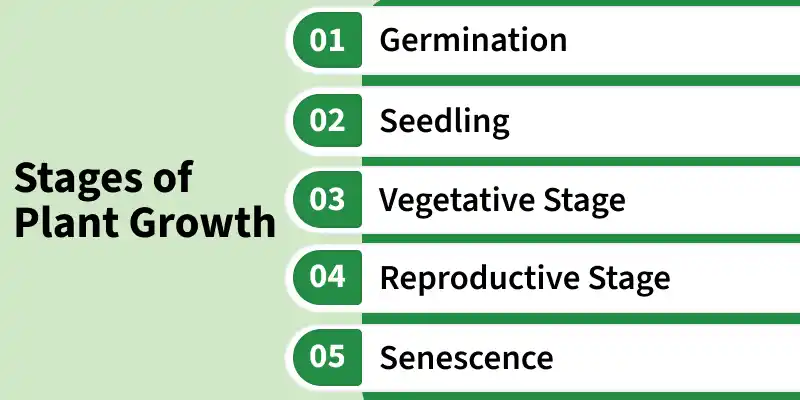
Characteristics of Plant Growth
Plant growth exhibits several key characteristics that distinguish it from non-living processes and transient changes. These characteristics are as follows:
- Plant growth is permanent and irreversible in nature.
- Growth occurs due to an increase in the number and size of cells.
- It requires energy obtained through metabolic activities.
- Growth takes place mainly in the meristematic regions of plants.
- Plant growth involves both constructive and metabolic processes.
- It leads to the formation of different tissues and organs.
- Plant growth continues throughout the life span of many plants.
- Growth is affected by environmental as well as genetic factors.
- It increases protoplasm and dry matter.
Phases of Plant Growth
Plant growth is a continuous biological process that occurs due to cell division, enlargement, and differentiation. The growth of a plant does not occur randomly but takes place in a systematic sequence of stages. These stages are known as the phases of plant growth.
1. Meristematic Phase
The meristematic phase is the initial phase of growth where cells actively divide by mitosis. This phase occurs in the apical meristems of roots and shoots. The cells in this region possess thin primary cell walls, dense cytoplasm, and large nuclei. Vacuoles are either absent or very small. The continuous division of cells increases the number of cells in the plant body.
2. Elongation Phase
The cells produced during the meristematic phase enter the elongation phase. During this phase, cells increase rapidly in size due to water absorption, vacuolation, and the synthesis of cellular components. The cell wall becomes elastic and extensible, allowing enlargement of cells. This phase contributes significantly to the increase in the length of roots and shoots.
3. Maturation Phase
In the maturation phase, cells attain their final size and shape and become specialised for performing specific functions. During this stage, differentiation occurs, and cells develop into permanent tissues such as xylem, phloem, parenchyma, collenchyma, and sclerenchyma.
Types of Plant Growth
Plant growth can be classified into different types based on the pattern and region of growth.
1. Primary Growth
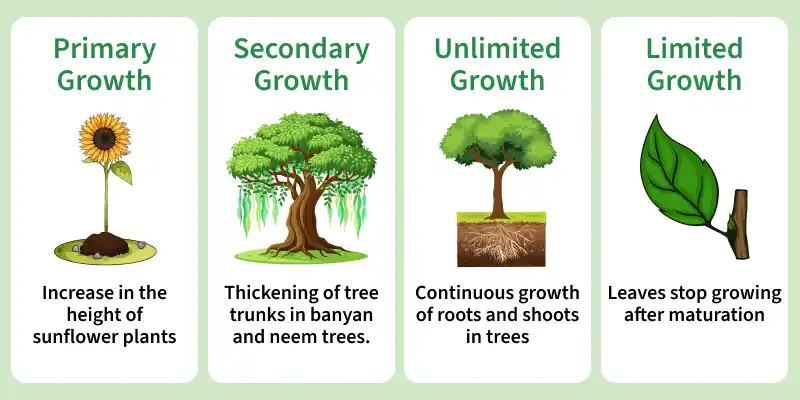
Primary growth refers to the increase in the length of roots and shoots due to the activity of apical meristems. This type of growth helps plants grow taller and allows roots to penetrate deeper into the soil for absorption of water and minerals. Primary growth produces the primary plant body and results in the formation of primary tissues.
**Examples of Primary Growth
- Increase in the height of sunflower plants.
- Elongation of roots in pea plants.
- Growth of young shoots in mango plants.
- Increase in stem length in wheat plants.
2. Secondary Growth
Secondary growth refers to the increase in the thickness or girth of stems and roots due to the activity of lateral meristems such as vascular cambium and cork cambium. Secondary growth mainly occurs in dicotyledonous plants and gymnosperms. This growth leads to the formation of secondary tissues and wood, making the plant stem stronger and capable of supporting large branches.
**Examples of Secondary Growth
- Thickening of tree trunks in banyan and neem trees.
- Formation of annual rings in woody plants.
- Increase in stem diameter in rose plants.
- Development of bark in trees.
3. Unlimited or Indeterminate Growth
In this type of growth, plants continue to grow throughout their life span because meristematic tissues remain active continuously.
**Examples of Indeterminate Growth
- Continuous growth of roots and shoots in trees.
- Growth of climbers and shrubs throughout life.
- Continuous branching in many perennial plants.
4. Limited or Determinate Growth
Limited growth, also known as determinate growth, is a type of plant growth in which a plant organ or part stops growing after reaching a particular size, shape, or stage of development. In this type of growth, cell division and enlargement occur only for a limited period of time.
**Examples of Determinate Growth
- Leaves stop growing after maturation.
- Fruits attain a fixed size after development.
- Flowers show limited growth.
- Mature roots of some plants stop elongating.
Factors Affecting Plant Growth
Plant growth is influenced by several external and internal factors. These factors regulate metabolic activities, enzyme action, and physiological processes in plants.
External Factors Affecting Plant Growth
- **Light: Light is one of the most important environmental factors affecting plant growth. It is essential for photosynthesis, chlorophyll formation, flowering, seed germination, and stomatal opening. Both the intensity and duration of light influence plant growth and development.
- **Temperature: Temperature affects the rate of enzymatic and metabolic activities in plants. Each plant species has a minimum, optimum, and maximum temperature range for proper growth. Very high or very low temperatures adversely affect plant growth by disturbing metabolic processes.
- **Water: Water is essential for maintaining cell turgidity, transporting minerals, carrying out photosynthesis, and facilitating biochemical reactions. Adequate water supply is necessary for proper plant growth. Deficiency of water causes wilting, stunted growth, and reduced metabolic activities.
- **Mineral Nutrients: Plants require essential mineral nutrients such as nitrogen, phosphorus, potassium, calcium, magnesium, sulphur, iron, and zinc for growth and development. Deficiency of minerals affects enzyme activity, chlorophyll synthesis, and cellular metabolism.
- **Oxygen: Oxygen is necessary for cellular respiration, which provides the energy required for growth and metabolic activities. Lack of oxygen reduces respiration and adversely affects root growth.
Internal Factors Affecting Plant Growth
Plant growth regulators or plant hormones are chemical substances produced naturally in plants that regulate growth and development.
- **Auxins: Auxins promote cell elongation, root initiation, apical dominance, and tropic movements.
- **Gibberellins: Gibberellins stimulate stem elongation, seed germination, flowering, and fruit development.
- **Cytokinins: Cytokinins promote cell division, delay leaf senescence, and stimulate lateral bud growth.
- **Abscisic Acid: Abscisic acid acts as a growth inhibitor and promotes dormancy and stomatal closure during water stress.
- **Ethylene: Ethylene promotes fruit ripening, leaf fall, and senescence.