CBSE Class 9 Maths Formulas (original) (raw)
Last Updated : 23 Jul, 2025
GeeksforGeeks present Maths Chapterwise Formulas for Class 9. This is designed for the convenience of the students so that one can understand all the important concepts of Class 9 Mathematics directly and easily. Math formulae for Class 9 are offered here for students who find the topic of mathematics to be a nightmare and difficult to grasp. They may become hesitant and lose interest in studies as a result of this. As a result, GeeksforGeeks mentioned all of the key formulae for the 9th standard Maths syllabus, which students may simply recall, to assist them in understanding Maths in an easy manner. For all courses such as Algebra, Geometry, Polynomials, and so on, the formulae are provided here according to the NCERT curriculum.
Chapter 1: Number Systems
The numeral or number system is the combination of natural, integers, rational, irrational, and real numbers. This lesson covers the entire concepts of the numeral system and its types, representation on the number line, laws of rational exponents, and integral powers. Any number that can be expressed as p ⁄ q, with p and q being integers and q ≠ 0 being rational numbers. The p ⁄ q form cannot be used to write irrational numbers.
- Any unique real number can be represented on a number line.
- If r is one such rational number and s is an irrational number, then (r + s), (r – s), (r × s) and (r ⁄ s) are irrational.
- Following rules must hold for positive real numbers:
- √ab = √a × √b
- √(a/b)= √a/√b
- (√a + √b) × (√a - √b) = a−b
- (a + √b) × (a − √b) = a2 −b
- (√a+√b)2 =a2 + 2√ab +b
- To rationalize the denominator of 1 ⁄ √ (a + b), then one must have to multiply it by √(a – b) ⁄ √(a – b), where a and b are both the integers.
- Suppose a is a real number (greater than 0) and p and q are the rational numbers.
- ap × bq = (ab)p+q
- (ap)q = apq
- ap / aq = (a)p-q
- ap / bp = (a/b)p
Chapter 2: Polynomials
Polynomial is an expression that comprises variables and coefficients which involves the operations like addition, subtraction, multiplication, and non-negative integer exponentiation of variables. A polynomial p(x) denoted for one variable ‘x’ comprises an algebraic expression in the form:
p(x) = anxn + an-1xn-1 + ….. + a2x2 + a1x + a0
where a0, a1, a2, …. an are constants where an ≠ 0
- Any real number; let’s say ‘a’ is considered to be the zero of a polynomial ‘p(x)’ if p(a) = 0. In this case, a is said to be the equation p(x) = 0.
- Every one variable linear polynomial will contain a unique zero, a real number which is a zero of the zero polynomial, and a non-zero constant polynomial that does not have any zeros.
- Remainder Theorem: If p(x) has the degree greater than or equal to 1 and p(x) when divided by the linear polynomial x – a will give the remainder as p(a).
- Factor Theorem: x – a will be the factor of the polynomial p(x), whenever p(a) = 0. The vice-versa also holds true every time.
Chapter 3: Coordinate Geometry
The coordinate geometry is a part of geometry where the position of the points on the plane is described with the help of an ordered pair of numbers called coordinates.
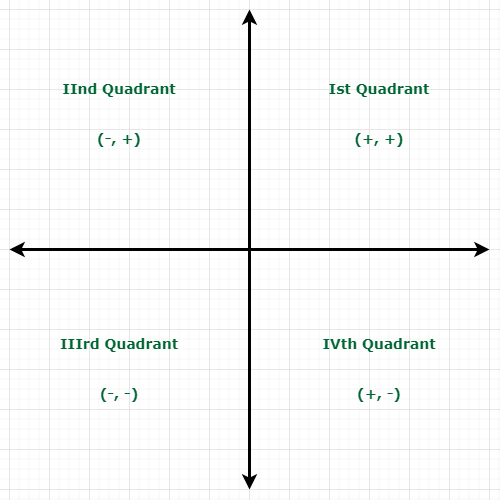
Coordinate geometry: Quadrants
Whenever you have to locate an object on a plane, you need two divide the plane into two perpendicular lines, thereby, making it a Cartesian Plane.
- The horizontal line is known as the x-axis and the vertical line is called the y-axis.
- The coordinates of a point are in the form of (+, +) in the first quadrant, (–, +) in the second quadrant, (–, –) in the third quadrant, and (+, –) in the fourth quadrant; where + and – denotes the positive and the negative real number respectively.
- The coordinates of the origin are (0, 0) and thereby it gets up to move in the positive and negative numbers.
Chapter 4: Linear Equations in Two Variables
Any equation which can be defined in the form ax + by + c = 0, where a, b and c are real numbers, and a and b are not both zero, is called a linear equation in two variables. Given below are the algebraic identities which are considered very important Maths formulas for Class 9.
- (a + b)2 = a2 + 2ab + b2
- (a – b)2 = a2 – 2ab + b2
- (a + b) (a – b) = a2 -b2
- (x + a) (x + b) = x2 + (a + b) x + ab
- (x + a) (x – b) = x2 + (a – b) x – ab
- (x – a) (x + b) = x2 + (b – a) x – ab
- (x – a) (x – b) = x2 – (a + b) x + ab
- (a + b)3 = a3 + b3 + 3ab (a + b)
- (a – b)3 = a3 – b3 – 3ab (a – b)
- (x + y + z)2 = x2 + y2 + z2 + 2xy +2yz + 2xz
- (x + y – z)2 = x2 + y2 + z2 + 2xy – 2yz – 2xz
- (x – y + z)2 = x2 + y2 + z2 – 2xy – 2yz + 2xz
- (x – y – z)2 = x2 + y2 + z2 – 2xy + 2yz – 2xz
- x3 + y3 + z3 – 3xyz = (x + y + z) (x2 + y2 + z2 – xy – yz -xz)
- x2 + y2 = 1212 [(x + y)2 + (x – y)2]
- (x + a) (x + b) (x + c) = x3 + (a + b + c)x2 + (ab + bc + ca)x + abc
- x3 + y3 = (x + y) (x2 – xy + y2)
- x3 – y3 = (x – y) (x2 + xy + y2)
- x2 + y2 + z2 – xy – yz – zx = 1212 [(x – y)2 + (y – z)2 + (z – x)2]
Chapter 5: Introduction to Euclid's Geometry
Euclidean geometry is the branch of geometry that deals with the study of geometrical shapes and figures based on different axioms and theorems. This study basically provides a brief explanation for flat surfaces.
- Axioms: The basic facts which are taken for granted without proof are called axioms. Some of Euclid's axioms are:
- Things which are equal to the same thing are equal to one another.
- If equals are added to equals, the wholes are equal.
- If equals are subtracted from equals, the remainders are equal.
- Things which coincide with one another are equal to one another.
- The whole is greater than the part.
- Postulates: Axioms are the general statements, postulates are the axioms relating to a particular field. Euclid's five postulates are.
- A straight line may be drawn from anyone point to any other point.
- A terminated line can be produced indefinitely.
- A circle can be drawn with any center and any radius.
- All right angles are equal to one another.
- If a straight line falling on two straight lines makes the interior angles on the same side of it taken together less than two right angles, then the two straight lines, if produced indefinitely meet on that side on which the angles are less than two right angles.
Chapter 6: Lines and Angles
The important formulas and some note points of Lines and Angles for class 9 notes are provided here. Here the various concepts such as parallel lines, transversal, angles, intersecting lines, interior angles are explained in brief.
- Angle: The union of two non-collinear rays with a shared beginning point is called an angle.
- Types of Angles: Following are the major types of angles-
- Acute angle:An acute angle measure between 0° and 90°.
- Right angle:A right angle is exactly equal to 90°.
- Obtuse angle:An angle greater than 90° but less than 180°.
- Straight angle:A straight angle is equal to 180°. Reflex angle: An angle that is greater than 180° but less than 360° is called a reflex angle.
- Complementary angles: Two angles whose sum is 90° are called complementary angles. Let one angle be x, then its complementary angle is (90°−x).
- Supplementary angles: Two angles whose sum is 180° are called supplementary angles. Let one angle be x, then its supplementary angle is (180°−x).
- Adjacent angles: Two angles are Adjacent when they have a common side and a common vertex (corner point) and don't overlap.
- Linear pair: A linear pair of angles is formed when two lines intersect. Two angles are said to be linear if they are adjacent angles formed by two intersecting lines. The measure of a straight angle is 180°, so a linear pair of angles must add up to 180°.
- Vertically opposite angles: Vertically opposite angles are formed when two lines intersect each other at a point. Vertically opposite angles are always equal.
- Transversal: A line that intersects two or more given lines at distinct points, is called a transversal of the given line. Following are the angles that are made on a traversal as,
1. Corresponding angles
2. Alternate interior angles
3. Alternate exterior angles
4. Interior angles on the same side of the transversal.
Chapter 7: Triangles
A triangle is a three-sided polygon with three edges and three vertices, as described by geometry. The Angle sum property of a triangle is the most significant and widely used characteristic, which states that the sum of a triangle's interior angles is only 180 degrees. Three sides and three angles make up a triangle, which is a closed geometrical object.
- Congruence: Congruent refers to figures that are identical in all aspects, such as their forms and sizes. Two circles with the same radii, for example, are congruent. Also congruent are two squares with the same sides.
- Congruent Triangles: Two triangles are congruent if and only if one of them can be superimposed over the other to entirely cover it.
- Congruence Rules: Following are the list of some important congruence rules of triangles,
- Side angle side (SAS) Congruence
- Angle Side Angle (ASA) Congruence
- Angle angle side (AAS) Congruence
- Side side side (SSS) Congruence
- Right-angle Hypotenuse Side (RHS) Congruence
Chapter 8: Quadrilateral
A quadrilateral is a plane geometrical figure which has four sides and has four corners or vertices. Typically, quadrilaterals are rectangle, square, trapezoid, and kite or irregular and uncharacterized figures with four sides. Here are some important properties and short notes about the chapter Quadrilateral:
- The Sum of all angles of a quadrilateral is 360°.
- A diagonal of a parallelogram divides it into two congruent triangles.
- In a parallelogram,
- diagonals bisect each other.
- opposite angles are equal.
- opposite sides are equal
- Diagonals of a square bisect each other at right angles and are equal, and vice-versa.
- A line through the mid-point of a side of a triangle parallel to another side bisects the third side. (Midpoint theorem)
- The line segment joining the mid-points of two sides of a triangle is parallel to the third side and equal to half the third side.
- In a parallelogram, the bisectors of any two consecutive angles intersect at a right angle.
- If a diagonal of a parallelogram bisect one of the angles of a parallelogram it also bisects the second angle.
- The angle bisectors of a parallelogram form a rectangle.
- Each of the four angles of a rectangle is the right angle.
- The diagonals of a rhombus are perpendicular to each other.
Chapter 9: Areas of Parallelograms and Triangles
The area of a plane figure is described as the amount of the planar surface covered by a closed geometric figure like rectangle, square, etc. A parallelogram is a type of quadrilateral that contains parallel opposite sides. Below-mentioned are the list of the formula used in the areas of parallelograms and triangles as,
- Area of Parallelogram = Base × Height
- Area of Triangle = 1/2 × Base × Height or 1/2 × Area of Parallelogram
- Area of Trapezium = 1/2 × (Sum of its parallel sides) × Distance between the two parallel side
- Area of Rhombus = 1/2 × Product of its two diagonals
Chapter 10: Circles
The locus of the points drawn at an equidistant distance from the center is known as a circle. The radius of a circle is the distance between its center and the outside line. The diameter of a circle is the line that divides it into two equal sections and is equal to twice the radius. Therefore in the Class 9 syllabus following important properties and formulas related to circles are discussed:
- Concentric circles are circles with the same center but different radii.
- Arc: An arc of the circle is a continuous portion of a circle.
- Chord: The chord of the circle is a line segment that connects any two locations on a circle. Some important properties of Chords of a circle are:
- The diameter of a circle is defined as a chord that passes across its center.
- A circle's diameter divides it into two equal sections, which are called arcs. A semi-circle is made up of these two arcs.
- If two arcs of a circle have the same degree of measure, they are said to be congruent.
- When two arcs have the same length, their associated chords are likewise the same length.
- The chord is bisected by a perpendicular drawn from the center to the chord of the circle, and vice versa.
- Three non-collinear points are intersected by one and only one circle.
- Equal circle chords are equidistant from the center.
- The line across the centers of two circles intersecting in two points is perpendicular to the common chord.
- An arc's angle at the center of the circle is double the angle it has throughout the rest of the circumference.
- Any two angles in the same circle segment are equal.
- A circle's equal chords form an equal angle at the center.
- The greater chord of a circle is closer to the center than the smaller chord.
- The semicircle has a right angle. At the circle's center, equal chords subtend an equal angle.
- Cyclic Quadrilateral: A quadrilateral is said to be cyclic if all of its vertices are on the perimeter of a circle.
- The sum of opposing angles in a cyclic quadrilateral is 180°, and vice versa.
- A cyclic quadrilateral's exterior angle is equal to its inner opposite angle.
- The tangent and radius of the circle intersect perpendicular to each other.
Chapter 11: Constructions
Chapter 11 of Constructions Class 9 demonstrates how to design various forms with a compass and ruler. This chapter explains how to create the bisector of a given angle, as well as how to make a perpendicular bisector of a given line segment, using construction stages and a clear picture. To get high grades, you should also be able to learn all of the relevant questions in the textbook for Class 9 Maths Chapter 11 construction problems. Following are the different rules to construct important geometrical figures:
- Construction of bisector of a line segment
- Construction of bisector of a given angle
- Construction of Equilateral triangle
- Construction of a triangle when its base, sum of the other two sides and one base angle are given
- Construction of a triangle when its base, difference of the other two sides and one base angle are given
- Construction of a triangle of given perimeter and two base angles
Chapter 12: Heron's Formula
A triangle is a closed three-dimensional shape in geometry. Here a student may find the Heron's formula and its important applications that are studied in Class 9 syllabus. Heron's formula is used to calculate the area of triangles. Following is the list of Heron's Formula and its some important applications:
- The semi-perimeter of a Triangle, s = (a+b+c)/2
- Area of the triangle = √{s(s−a)(s−b)(s−c)} sq. unit.
- For an Equilateral Triangle with side a:
- Its Perimeter = 3a units
- Its Altitude = √3/2 a units
- Its Area = √3/4 a2 units
Chapter 13: Surface Areas and Volumes
Surface Area is one of the most essential subtopics in class 9 Surface Areas and Volumes. When we calculate the space occupied by a two-dimensional item, we call it area and measure it in square units; however, when we calculate the space occupied by a three-dimensional object, we call it surface area and measure it in square units as well. There are two sorts of surface areas:
- Total Surface Area (TSA): The whole area covered by the object's surface is called the Total Surface area. Following is the list of the total surface areas of some important geometrical figure-
- TSA of a Cuboid = 2(l x b) +2(b x h) +2(h x l)
- TSA of a Cube = 6a2
- TSA of a Right circular Cylinder = 2πr(h+r)
- TSA of a Right circular Cone = πr(l+r)
- TSA of a Sphere = 4πr2
- TSA of a hemisphere = 3πr2
- Lateral/Curved Surface Area: The curved surface area is the area of only the curved component, or in the case of cuboids or cubes, it is the area of only four sides, excluding the base and top. It's called the lateral surface area for forms like cylinders and cones.
- CSA of a Cuboid = 2h(l+b)
- CSA of a Cube = 4a2
- CSA of a Right circular Cylinder = 2πrh
- CSA of a Right circular Cone = πrl
- Volume: The volume of an object or material is the amount of space it takes up, measured in cubic units. There is no volume in a two-dimensional object, only area. A circle's volume cannot be calculated since it is a 2D figure, while a sphere's volume can be calculated because it is a 3D figure.
- Volume of a Cuboid = l x b x h
- Volume of a Cube = a3
- Volume of a Right circular Cylinder = πr2h
- Volume of a Right circular Cone = 1/3πr2h
- Volume of a Sphere = 4/3πr3
- Volume of a hemisphere = 2/3 πr3
Here, l is the length, b is the breadth, h is the height, r is the radius and a is the side of the respective geometrical figure.
Chapter 14: Statistics
Statistics is the study of the representation, collection, interpretation, analysis, presentation, and organization of data. In other words, it is a mathematical way to collect, summarize data. The representation of data differently along with the frequency distribution. Certain facts or figures which can be collected or transformed into some useful purpose are known as data. These data can be graphically represented to increase readability for people. Below mentioned is the brief summary of this chapter:
- Class mark = (Lower Limit + Upper Limit)/2
- The three central tendencies are measured as:
- Mean (x‾) = Sum of all observations (∑xn) / Total Number of observation (N)
- Median = The median for even number of observation is equal to the middlemost observation whole for the odd number of observation it is equal to value of ((n+1)/2)th observation.
- Mode = It is equal to observation which occurs the most or have the maximum frequency in the given data.
Chapter 15: Probability
The Probability in this class includes basic probability theory, which is also used in the probability distribution, to learn the possibility of outcomes for a random experiment and to find the probability of a single event to occur, when the total number of possible outcomes. Probability is the possibility of any event likely to happen. The probability of any event can only be from 0 to 1 with 0 being no chances and 1 being the possibility of that event to happen.
- Probability P (E) = Number of favorable outcomes / Total Number of outcomes
- The probability of any event only lies between 1 and 0.
- Trial: It is defined as the set of observations of event in which one or more outcomes are observed.
- Event: It is defined as the collection of observation performed to observe an experiment.