Cracking the System Design Interview Round (original) (raw)
Last Updated : 16 Apr, 2026
A System Design Interview evaluates your ability to design scalable and reliable systems while clearly explaining your approach. It focuses on handling open-ended problems, making trade-offs, and structuring solutions effectively.
- Focus on understanding the problem and clearly defining requirements first, then explain design choices, scalability, and trade-offs in a structured way.
- Break the system into components, describe their interactions, and ensure the overall architecture is easy to understand and scalable.
**Example: Design a URL Shortener (like bit.ly).
- Take a long URL as input and generate a short, unique URL
- Store and retrieve the original URL when the short link is accessed
- Design for scalability so millions of users can create and use short links
Steps to Crack System Design Round in Interviews
This section outlines a structured, step-by-step approach to effectively handle system design interviews.
Apart from that, if you want to crack the interview rounds smoothly then enroll now with GeeksforGeeks **Mastering System DesignCourse, mentored by experts.
Step 1. Understand the Goal and Gather All the Requirements
System design interview questions, by nature, are unclear or abstract. Asking questions about the exact scope of the problem, and clarifying functional requirements early in the interview is essential.
Usually, requirements are divided into three parts:
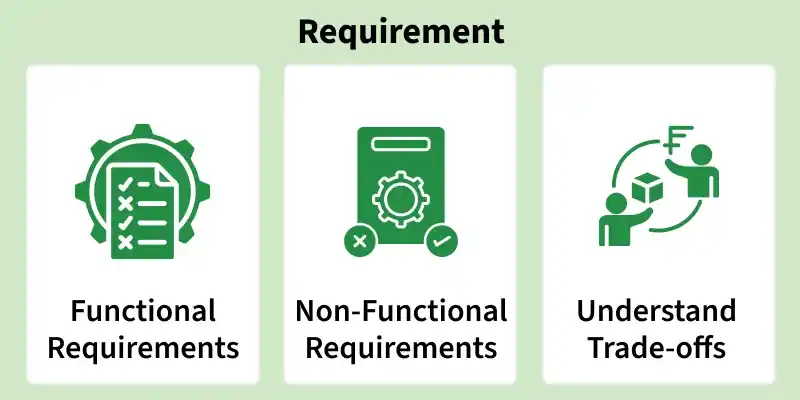
Requirement
**1. Functional Requirements
Functional requirements are the requirements that the end user specifically demands as basic functionalities that the system should offer. All these functionalities need to be necessarily included into the system as part of the contract.
**Example:
- "What are the features that we need to design for this system?"
- "What are the edge cases we need to consider, if any, in our design?"
**2. Non-Functional Requirements
Non-Functional Requirements are the quality constraints that the system must satisfy according to the project contract. The priority or extent to which these factors are implemented varies from one project to another. They are also called non-behavioral requirements. For example, portability, maintainability, reliability, scalability, security, etc.
**Example:
- "Each request should be processed with the minimum latency"
- "System should be highly available"
**3. Extended requirements
These are basically "nice to have" requirements that might be out of the scope of the system.
**Example:
- "Our system should record metrics and analytics"
- "Service health and performance monitoring?"
Step 2. Understand the Estimation and Constraints
Estimate the scale of the system we're going to design. focus on the system’s expected scale (like user volume and request rates) and practical limits (like latency and budget). This helps guide your design choices, ensuring the solution can handle expected demand. It is important to ask questions such as:
- What is the desired scale that this system will need to handle?
- What is the read/write ratio of our system?
- How many requests per second?
- How much storage will be needed?
These questions will help us scale our design later.
Step 3. High-level component design
Now it's time to identify system components (such as Load Balancers, API Gateway, etc.) that are needed to solve our problem and draft the first design of our system and outline the flow of data between them. This gives an organized view of the system’s architecture and sets up a foundation for further detailed design.
- Is it best to design a monolithic or a microservices architecture?
- What type of database should we use?
Once we have a basic diagram, we can start discussing with the interviewer how the system will work from the client's perspective.
Step 4. Define the Data Model / Database Design
Now we can start with defining the database schema. Doing so would help us to understand the data flow which is the core of every system. In this step, we basically define all the entities and relationships between them.
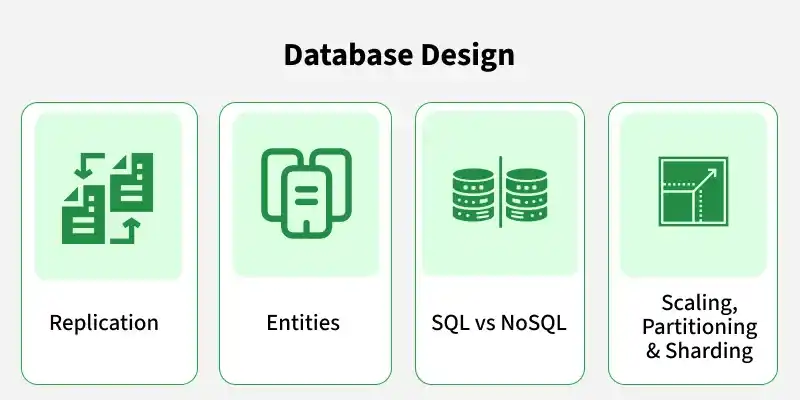
- What are the different entities in the system?
- What are the relationships between these entities?
- How many tables do we need?
- Is NoSQL a better choice here?
Step 5. API design
Next, we can start designing APIs for the system.
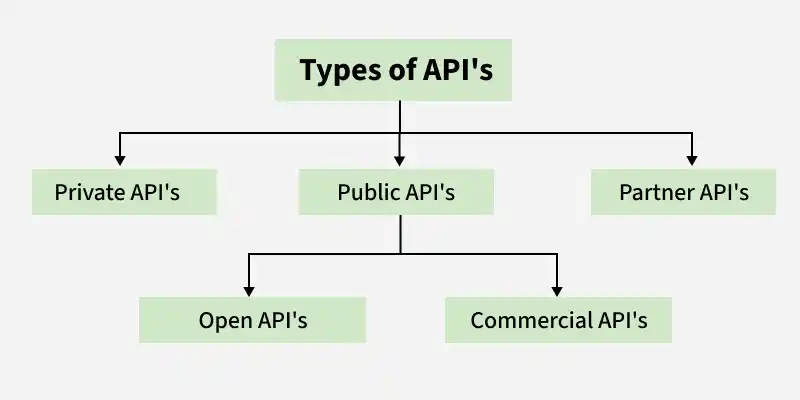
Types of API
These APIs will help us define the expectations from the system explicitly. We don't have to write any code, just a simple interface defining the API requirements such as parameters, functions, classes, types, entities, etc.
Example:
createUser(name: string, email: string): User
It is advised to keep the interface as simple as possible and come back to it later when covering extended requirements.
Step 6. Detailed design
Now it's time to go into detail about the major components of the system we designed. As always discuss with the interviewer which component may need further improvements.
Here is a good opportunity to demonstrate your experience in the areas of your expertise. Present different approaches, advantages, and disadvantages. Explain your design decisions, and back them up with examples.
- How should we partition our data?
- What about load distribution?
- Should we use cache?
- How will we handle a sudden spike in traffic?
Also, try not to be biased about certain technologies, statements like "I believe that NoSQL databases are just better, SQL databases are not scalable" reflect the candidate's understanding very poorly.
Step 7. Identify and resolve bottlenecks
Now at this point you can discuss bottlenecks in the system and approaches to mitigate them. Here are some important questions to ask:
- Do we have enough database replicas?
- Is there any single point of failure?"
- "Is database sharding required?"
- "How can we make our system more robust?"
- "How to improve the availability of our cache?"
Make sure to read the engineering blog of the company you're interviewing with. This will help you get a sense of what technology stack they're using and which problems are important to them.
Most Frequently asked Problems for System Design
Below, are some question which is most frequently asked in system design for designing purpose:
- Design URL Shortener like TinyURL
- Design Youtube
- Design Netflix
- Design Facebook
- Design Google Maps
- Design Autocomplete for Search Engines
- Design Uber
- Design Spotify
- Design Rate Limiter
- Design Parking Garage
- Design Vending Machine
Quick Tips and Strategies for Succeeding in System Design Interview Round
Try to follow the 80-20 rule during your interview, where 80% of the time you will be speaking and explaining everything and 20% of the time your interviewer. Don't use buzzwords and don't pretend to be an expert if you don't know something.
- Avoid using buzzwords (e.g., NoSQL, MongoDB, Cassandra) without understanding them, as interviewers may ask for justification.
- Be prepared to explain why you chose a particular technology or design.
- Do not go into too much detail too early; start high-level and wait for interviewer feedback.
- Manage time carefully and avoid over-explaining one component while ignoring others.
- Do not force a fixed architecture (like MVC or event-driven) if it doesn’t fit the requirements.
- Stay flexible, as requirements may change during the interview.
- Be honest about your experience with technologies and show confidence and willingness to learn.
Do's and Don'ts in System Design Interview Round
Let’s try to make it simple and discuss some key points before you start your preparation for this round.
- Treat the interviewer like a teammate and approach the round as a collaborative problem-solving discussion.
- Take ownership and lead the design, as if you are building a real-world system for a company.
- The goal is to evaluate your ability to design large-scale systems and explain your thinking clearly.
- Clarity of thought and communication is more important than the final architecture.
- Focus on presenting a well-reasoned approach to open-ended problems rather than a perfect solution.